Why do some people always lack money, while others become richer?, The money-making wisdom of the Babylonian rich
7minThe Money Book, How to Create a Money System
7minKey lessons learned from Seino’s teachings
3minLove Lessons
4minDesign Your Language
4minThe Money Book, How to Create a Money System
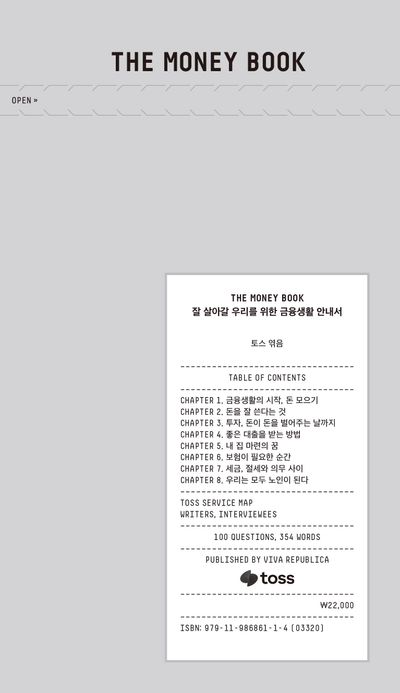
Just as important as making money is how to create a flow for spending the money.
If you need basic economic common sense or a comprehensive financial guide, I recommend this book by Toss.
Part1. Money flow design - ‘Bank account splitting and automation’
The reason we are unable to save money is often because it is mixed in one bank account or funds are not managed properly.
The book recommends four structures: ① Salary account (hub where salary is received), ② Consumption account (automatic transfer of living expenses and fixed expenses), ③ Emergency fund account (3 to 6 months' worth of living expenses), and ④ Investment/savings account.
By immediately making an automatic transfer to each bank account, the idea is not to ‘save the remaining money,’ but to ‘spend the remaining money after saving.’
It is advised to keep your emergency fund in a CMA or parking account that accrues interest even if you leave it for just one day, but can also be withdrawn immediately.
Part 2. The invisible asset called credit — ‘Credit score and loans’
Credit is redefined as an invisible asset that determines the price (interest rate) of borrowing money.
Credit score is an individual's repayment reliability calculated on a scale of 0 to 1000 by credit rating agencies such as NICE and KCB in Korea. For example, even for the same 100 million won home mortgage loan, if the interest rate changes by just 1 percentage point depending on credit rating, the difference is 1 million won per year, or tens of millions of won over 30 years.
If you have no transaction history, such as not using a credit card, there is no basis for evaluation, which can be disadvantageous.
This is because your credit score cannot be raised overnight when you actually need a deposit loan or a home mortgage loan (usually in your 30s). The key is that credit is not something you create when you need it, but rather an asset you build up in advance.
Part 3. Stopping money leaks — ‘Insurance and fixed spending diet’
The essence of insurance is not ‘savings’ but ‘risk transfer’.
They tell people to be wary of the trap of being recommended as 'investment' for products with high operating expenses and low refund rates, such as whole life insurance and variable insurance. Protection should be separated into insurance, and savings should be separated into savings and investment.
If you are a person responsible for the actual cost of medical expenses (covering actual hospital expenses) and your family's livelihood, an inexpensive term insurance (death insurance that covers only a certain period of time) is sufficient, and we advise you to boldly eliminate special contracts with overlapping coverage and special contracts attached to risks with an extremely low probability of occurrence.
If you cancel three OTT subscriptions you don't use, you'll automatically save tens of thousands of won per month without any effort, and if you switch carriers to a budget phone, you'll automatically save hundreds of thousands of won per year.
Part 4. Don’t be deprived of it — ‘Taxes and year-end settlement’
The key is to accurately distinguish between income deductions and tax deductions.
Income deduction reduces the ‘taxable income’ itself (typically credit/check card usage and housing subscription savings),
Tax deductions are directly subtracted from calculated taxes (pension savings, IRP, monthly rent, donations). The tax credit has a great tangible effect. For example, if you make annual contributions to pension savings or IRP, there is a 'double effect' of receiving a certain percentage of the amount (13.2-16.5% depending on the income range) directly back in taxes while also accumulating retirement funds.
The deduction rate for check cards and cash receipts is higher than for credit cards. So, the book gives practical tips as a card usage strategy at the beginning of the year, such as "Use a credit card with good benefits for up to 25% of your annual salary, and use a check card with a high deductible for the excess amount."
The idea is to plan your year by being conscious of deduction items from the beginning of the year. To the extent that taxes are legally reduced, they become my assets, and this effect is more certain than any investment return.
Part 5. The ladder to owning a home — ‘Subscription and lease’
The focus is on the Jeonggong method, which allows homeless people to purchase their own homes relatively cheaply by utilizing the system.
Housing Subscription Savings is an account used to qualify for apartment sales. The key is to put in ‘for a long time and consistently’.
The subscription winnings are divided into an additional point system (scoring points for the period of no housing, number of dependents, and subscription account subscription period) and a lottery system. The longer the subscription period, the more points are accumulated, so it is emphasized that at least you should open a subscription account first and automatically transfer even a small amount every month. In addition, the subscription savings payment amount comes with the income deduction benefits mentioned earlier.
The structure and risks of the jeonse system are also explained. Jeonse is a unique system in Korea where you deposit a lump sum of money (deposit) and live without monthly rent, but it comes with the risk of ‘jeonse fraud/tin-lease’ where the landlord cannot return the deposit.
We provide practical guidance on the ‘three types of safety devices’: ① check the mortgage and senior claims with a certified copy of the register before signing the contract, ② secure opposing power and priority repayment rights by receiving a move-in report + confirmation date immediately on the balance date, and ③ sign up for rental deposit return guarantee insurance.
Part 6. The first step to making money — ‘The Basics of Investment’
Take the power of compound interest as a starting point. Unlike simple interest, in which interest is accrued only on the principal, compound interest accrues interest on the interest, and your assets grow exponentially over time.
It's the 'Rule of 72' — if you divide 72 by the annual rate of return, you get the number of years your principal will double (about 12 years at 6% per year). Therefore, it emphasizes the compound interest of time: “A small amount of money started early beats a large amount of money started late.”
As an investment method, we recommend diversification and savings investment (ETF, index fund) rather than 'one shot' of individual stocks. Index investment, which buys the entire market, has a small impact even if one company fails, and the savings method (dollar cost averaging method), which mechanically deposits the same amount every month, lowers the average purchase price by buying less when it is expensive and more when it is cheap. This is a way to structurally avoid the most common pitfalls of beginners who fail while trying to get the timing right on ‘when to buy’.
Managing the money you keep is managing the money you earn.
? TOP 5 KEY INSIGHTS
- Don’t write it down and leave it behind, take it off and write it down. Savings are made by automatic transfer, not by will. If you create a structure where savings and investments are withdrawn first the day after payday, half of the money management is done.
- Your credit score is a price tag for the interest you will pay throughout your life. I can't make it in a hurry when I need it. If you build up a history of credit transactions, even if it is just a small amount, early on, you will save tens of millions of won in interest when you actually need a large loan.
- Separate protection into insurance and savings into investment. If you avoid the pitfalls of savings insurance and focus on actual loss and term insurance, the leaked insurance premiums become seed money.
- Fixed costs reduced once beat the savings endured every day. It is efficient to start with items that can save you a lifetime with a single decision, such as unused subscriptions and expensive communication bills.
- Reducing taxes is the most certain rate of return. Money returned legally, such as pension savings, IRP tax deductions, and card use strategies, is a fixed return with no volatility. Bonuses for the 13th month must be planned from the beginning of the year to be received.
99% of money management is not determined by fancy investments, but by tedious systems that plug leaks and automate flows.