Samsung vs SK Hynix: the HBM battle that will decide Korea's AI chip future
3minTSMC and the AI chip bottleneck Wall Street can't price correctly
3minThe Nvidia market worth watching now isn't data centers - it's robots
2minWhy Did the Space Sector Suddenly Collapse? June's Selloff Explained
3minBig Tech's Data Center Spending This Year Is Not 725 Trillion Won - It's Dollar-Scale
2minThe Nvidia market worth watching now isn't data centers - it's robots
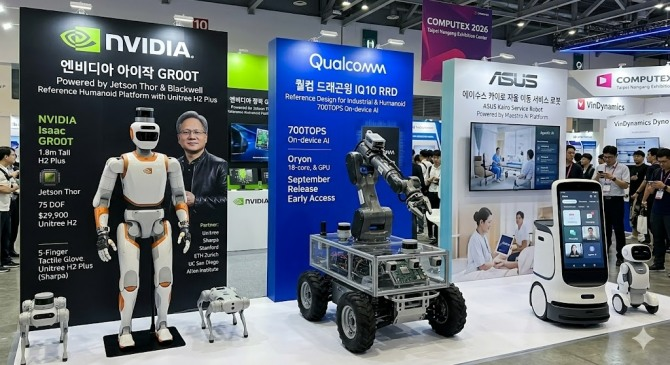
When people talk about Nvidia, they almost always mean one thing: the chips powering AI data centers. That business is still the engine — Nvidia said its newest Grace Blackwell systems are selling well and its next generation, Vera Rubin, has entered full production. But if you want to understand where the company is pointing next, watch a different market entirely: physical AI, meaning robots that move and act in the real world.
Why is Jensen Huang flying to Seoul?
In early June, Nvidia CEO Jensen Huang visited Korea and sat down with companies like LG and Hyundai. The headline wasn't about selling more data-center chips. It was about robotics. LG is working to pair its home humanoid robot with Nvidia's Isaac robotics software, and a cluster of LG affiliates is lining up around it — displays built for robots, vision-sensing systems, batteries made for machines that walk.
Huang has been blunt about the size of the prize. He has described the market for humanoid robots and automated labor as potentially worth tens of trillions of dollars, a number so large it sounds unserious until you remember he was early and right about AI data centers too.
The first wave of AI lived on screens and answered questions. The next wave, Nvidia is betting, will have arms and legs and do the work.
How big is this actually?
The global robotics market in 2026 sits at roughly 38 billion dollars, having grown about 34% in a year. Industry forecasts suggest that by 2035, somewhere around 145 million physical-AI devices could ship annually, pushing that market toward 300 billion dollars. Those are projections, not promises, but the direction is clear enough that Nvidia is staffing research centers and hiring roboticists rather than just selling parts.
For someone watching the stock, the takeaway is less "buy" or "sell" and more about what story you're underwriting. Nvidia's valuation already assumes it dominates AI computing. The robotics push is a second, longer bet layered on top — one where the customer isn't a cloud company renting servers, but a carmaker, a warehouse, or eventually a household. It's earlier, messier, and years from mattering to earnings. But it explains why the CEO keeps showing up in person where the robots are being built.
This article is for informational purposes only and is not investment advice.