Ray-Ban Meta vs. Oakley Meta AI Glasses: Features, Differences, and How to Try Them In-Store
Meta's AI glasses line now has two distinct faces: the fashion-forward Ray-Ban Meta and the sports-performance Oakley Meta. Both run the same underlying platform, but they are aimed at different people and different moments in a day. This guide covers what each product actually does, where the two diverge, and the most practical thing you can do before buying — try them on in a physical store.
Ray-Ban Meta: What It Is

The current Ray-Ban Meta glasses are the second generation of the Ray-Ban Stories collaboration. They ship with an upgraded 12MP ultrawide camera that can capture stills and 60-second video clips, open-ear speakers with improved bass, five microphones tuned for outdoor voice pickup, and a revised battery that gets around six hours of mixed use. A charging case extends that to roughly 36 hours total.
The key software layer is Meta AI, accessible hands-free. You can ask it to identify what you are looking at, translate text in real time, draft a message, or answer questions — all without touching your phone. A multimodal mode lets Meta AI process what the camera sees alongside your spoken query, which works well for reading menus, price tags, or street signs in a foreign language.
Price: $329–$379 depending on frame style and lens type. Prescription lenses are available through Ray-Ban's optical program.
Available since: October 2023 (Gen 2); software updates through 2025–2026 have expanded Meta AI capabilities significantly.
Frame styles: Wayfarer, Headliner, Round, Skyler, Skyler Sport — the Headliner's wider wraparound lens gives the camera the best field of view.
Oakley Meta: What It Is
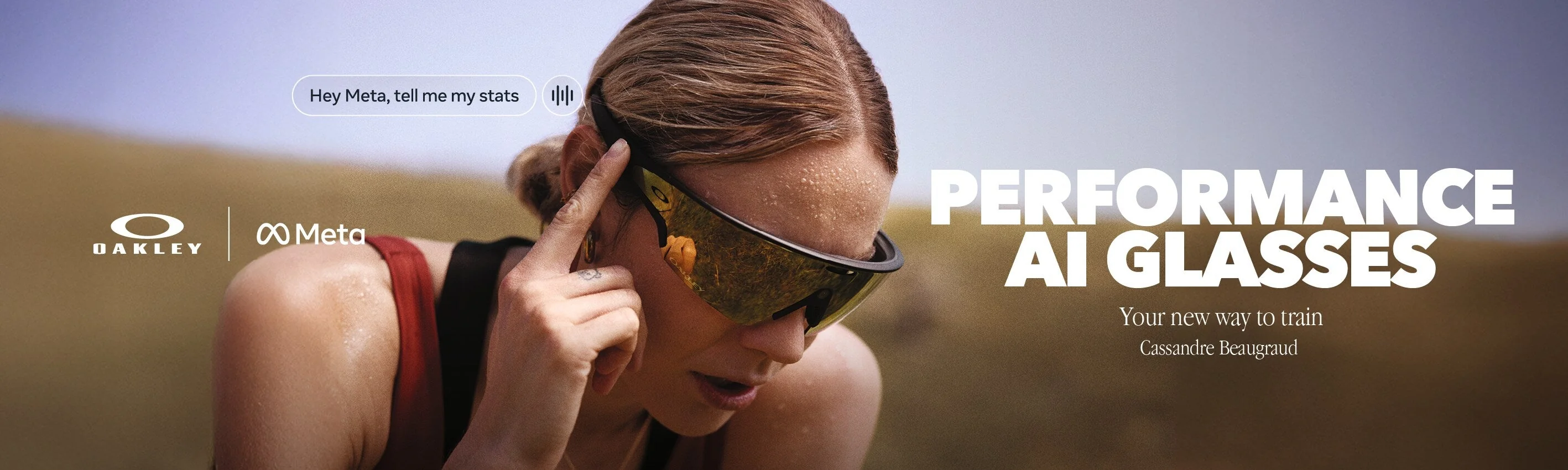
Oakley Meta uses the identical hardware core — same camera, same chipset, same Meta AI integration — inside Oakley's Sphaera sports frame with Prizm lens technology. Prizm lenses are color-tuned for specific environments (road cycling, trail running, water sports) to increase contrast where it matters most for the activity.
The frame itself is designed for secure fit at speed: a three-point grip system, a nose pad geometry optimized for helmets and goggles stacking, and an O-Matter frame material that resists impact better than standard acetate. The open-ear speakers sit flush rather than protruding, which matters when you are wearing a cycling helmet over them.
Price: $499 standard; higher with Prizm prescription lenses.
Available since: Late 2024.
Frame styles: Sphaera is the primary frame; Oakley has indicated additional sport-specific frames are in development.
Key Differences Between the Two
Feature Ray-Ban Meta Oakley Meta Target use Everyday lifestyle, social, travel Outdoor sport, cycling, running Frame Fashion frames (acetate, metal) Sphaera sport frame (O-Matter) Lens technology Standard tints, polarized available Prizm color-tuning per activity Secure fit Standard optical fit 3-point grip, helmet-compatible Price entry point $329 $499 AI platform Meta AI (identical) Meta AI (identical) Camera 12MP ultrawide (identical) 12MP ultrawide (identical) Battery ~6 hours (identical) ~6 hours (identical)
The practical summary: if the AI features are your primary reason for buying and you will wear them in everyday settings, Ray-Ban Meta is the right choice and it costs $170 less. If you train outdoors regularly and want Prizm lens performance alongside the AI layer, Oakley Meta justifies the premium — but only if you would have bought Oakley sport glasses anyway.
Where to Try Them On: Offline Store Guide
Both products have things that cannot be evaluated from a spec sheet: how the open-ear audio sounds in an ambient environment, how the Meta AI response latency feels during a conversation, and whether the frame fits your face the way you need it to. An in-store visit of at least 20 minutes resolves all three questions.
Ray-Ban Meta
Ray-Ban boutiques and authorized optical retailers are the primary in-store channel. In most major cities, the following types of stores carry demo units:
Ray-Ban flagship boutiques — these always have demo units connected to Meta AI and will walk you through the hands-free activation sequence.
LensCrafters and Sunglass Hut (US/Canada) — LensCrafters locations with Ray-Ban displays often carry Meta glasses; Sunglass Hut mall kiosks carry the non-prescription versions.
EssilorLuxottica-affiliated optical chains (EU, Korea, Australia) — Ray-Ban's parent company owns or licenses these stores. In Korea, Lotte Department Store optical counters and Shinsegae optical in flagship locations typically stock them.
Ray-Ban website store locator — use the "Find a store" tool and filter for "Meta glasses" to find nearby locations with confirmed stock.
What to expect in-store: The sales associate will pair the demo glasses to a store device or their own phone to enable Meta AI. You will be able to try the voice activation ("Hey Meta"), take a test photo, and hear the speaker quality in the store environment. Ask specifically to test Meta AI's visual mode — point the camera at a product in the store and ask Meta AI to describe it. That is the most useful demo for judging real-world latency.
Booking: Most Ray-Ban boutiques do not require an appointment for a try-on. Walk-in is standard. High-traffic locations (malls, tourist areas) may have a short wait on weekends. If you want prescription lens fitting alongside the try-on, book an optical appointment in advance.
Oakley Meta
Oakley Meta requires a more deliberate in-store visit because the sport fit matters as much as the AI features. A frame that slips during a sprint or sits poorly under a helmet is a product problem that no amount of AI capability fixes.
Oakley flagship stores — these are the best place to try Oakley Meta. Staff at flagships are trained on sport fit and can adjust the three-point grip for your head shape. Flagship locations are in major cities and some resort areas near ski and cycling communities.
Certified Oakley dealers — sporting goods chains that carry Oakley eyewear (e.g., REI in the US, specialist cycling shops in Europe) sometimes have Oakley Meta. Call ahead to confirm they have a demo unit rather than just sealed retail boxes.
Oakley website store locator — search for "Oakley Meta" under the Eyewear category to filter for locations with confirmed stock.
What to expect in-store: Plan for a 20–30 minute visit if you want a full fit check. Bring the helmet or cycling cap you normally train in — the staff can verify the glasses sit correctly when stacked. Ask to hear the speakers at a volume you would actually use outdoors (they are louder than they sound in a quiet store). If you are considering Prizm prescription lenses, the optical specialist needs to take measurements that cannot be done at home.
Booking: Oakley flagship stores accept walk-ins for eyewear try-ons. If you want a prescription consultation alongside the Oakley Meta demo, book an optical appointment ahead of time — prescription fitting requires a trained optician and typically takes 30–45 minutes separate from the product demo.
Who Should Buy Each Model
Buy Ray-Ban Meta if:
You want AI glasses for everyday use — commuting, travel, meetings, social settings
Style and social acceptance matter to you (Ray-Ban frames are recognizable; they do not signal "tech product" the way bulkier smart glasses do)
You want prescription options at a lower price point
You are testing the category for the first time and do not want to over-invest
Buy Oakley Meta if:
You train outdoors regularly (cycling, running, hiking, skiing) and Prizm lens tuning would improve your performance in those environments
You already buy Oakley sport eyewear and the $499 price is in the range of what you would spend anyway
Secure fit at speed is non-negotiable — a sliding frame during a descent or a sprint is a safety issue, not just an annoyance
You want the AI features available during sport without carrying your phone in hand
Neither is right if:
You are expecting an AR display — neither product has one. These are AI glasses, not augmented reality glasses. The only visual output is through your phone screen or spoken through the speakers.
You want fully private AI — Meta AI processes queries through Meta's servers. If data privacy is a hard requirement, these products are not the right fit.
You are hoping for a camera replacement — the 12MP camera is good enough for contextual capture, but it is not a GoPro substitute for serious sports documentation.
Final Note
The in-store try-on is genuinely the most important step for either product. The speaker quality, AI response latency, and physical fit are all things that specification sheets do not communicate accurately. Both Meta and Oakley stores are well-staffed for this category — use them. Thirty minutes in a store is worth more than an hour of reading reviews for a wearable you will have on your face every day.