The Future of the XR Industry: Where AR, VR, and AI Converge
The extended reality industry has been promising a revolution for a decade. The hype cycles have come and gone — Google Glass, the original Oculus DK1, Magic Leap's billion-dollar bet on enterprise AR. What is different now is that the hardware is actually shipping in volume, the AI layer is real, and the developer ecosystems have crossed a maturity threshold that makes building on them a reasonable bet rather than a science experiment.
Here is where things stand in mid-2026, and where I think they go next.
The Current State: Key Players and Where They Stand
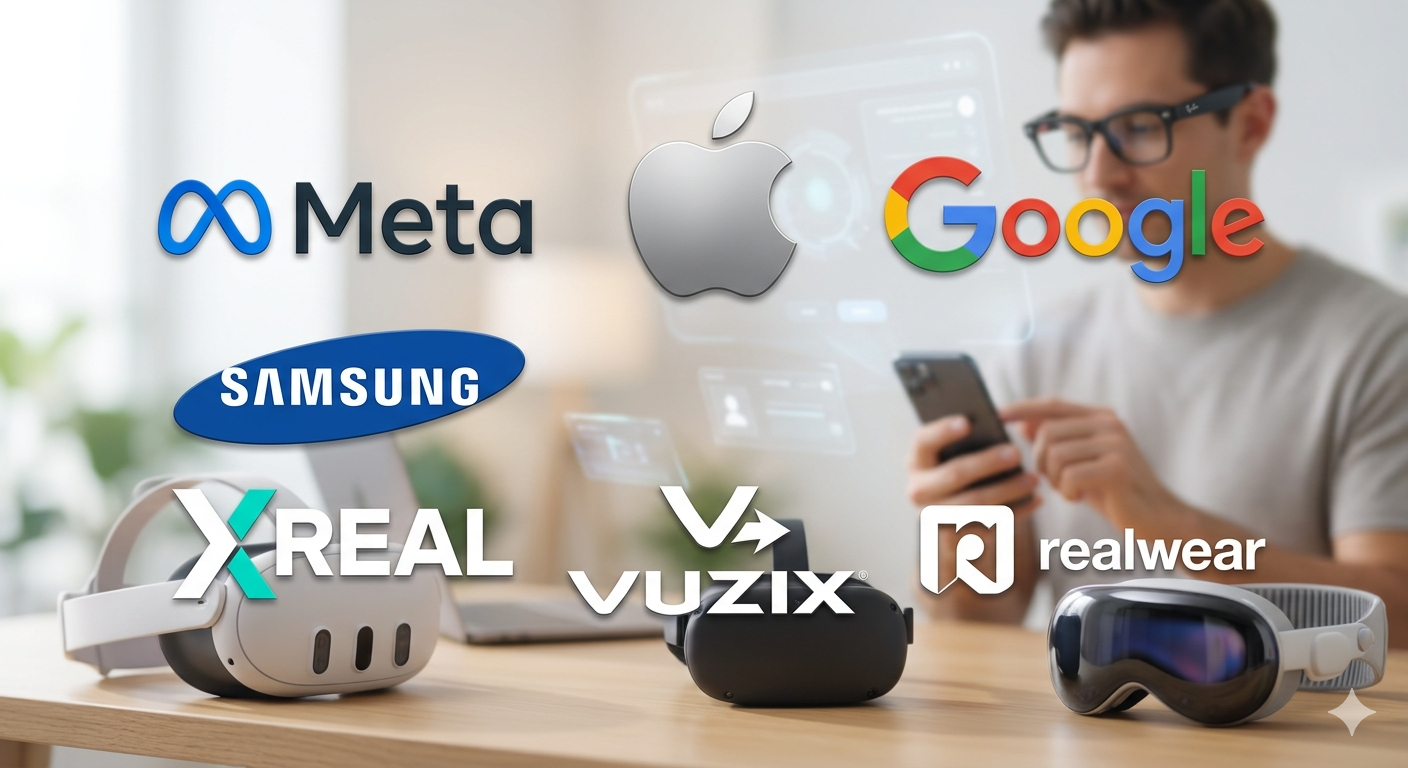
Meta is the only company that has demonstrated it can sell XR hardware at consumer scale. Quest 3 moved millions of units. Ray-Ban Meta and Oakley Meta proved that AI glasses can reach a mainstream audience when the form factor is something people actually want to wear. Meta's bet is vertical integration: own the social layer, own the assistant, own the platform, and let developers build on top. It is working better than most industry observers expected three years ago.
Apple entered spatial computing with Vision Pro — a $3,499 device that is not a mainstream consumer product by design. It is Apple's visionOS reference platform: a way to establish the interaction paradigms, the SDK, and the developer community before the form factor collapses to something normal people will wear. Apple Intelligence is the connective tissue between Vision Pro and iPhone, and every year that passes makes the integration tighter. Apple is playing a long game, and the company has the balance sheet to do it.
Google and Samsung joined forces on Android XR, announced at Google I/O 2024. Project Moohan — Samsung's headset — is the first Android XR device. The strategic logic is clear: Google wants to be the open-platform layer for spatial computing the way Android is for mobile. Samsung provides the hardware credibility. The risk is the same risk Android always carries: fragmentation, inconsistent experiences across devices, and the challenge of getting developers to build for a new interaction model when the install base is still small.
Smaller players — XREAL, Vuzix, RealWear — occupy niches. XREAL targets productivity users who want a large virtual screen for laptop work. Vuzix and RealWear serve enterprise and industrial use cases where the ROI is clear and the form factor doesn't need to be fashionable. These markets are real and growing, but they are not where the platform wars are being fought.
Near-Term Trends: AI Glasses and the Spatial OS Race
The most important trend of the next 24 months is the acceleration of AI-powered glasses toward a phone-replacement posture. This is not a prediction that glasses will replace phones in 2027 — they will not. It is a prediction that glasses will increasingly handle the use cases that currently require pulling out your phone: quick questions, translation, navigation prompts, photo capture, message replies. Each use case that migrates to glasses is a use case where the phone stays in your pocket.
Meta AI on Ray-Ban Meta already handles more of this than most people realize. The live translation feature, the visual search, the real-time audio notes — these are phone-replacement workflows running on a 50g wearable. The next generation of these glasses will have better cameras, lower latency AI processing (some on-device, some offloaded to a companion phone or cloud), and tighter integration with calendar, messaging, and payments.
The spatial OS race is subtler. Both visionOS and Android XR are trying to define what "computing in space" means at the operating system level: how windows are placed and moved, how notifications surface, how identity and permissions work when the device is worn rather than held. These interface paradigms will harden over the next two years, and the choices made now — how deep links work in visionOS, how Jetpack Compose translates to 3D space in Android XR — will shape developer behavior for a decade.
The Real Challenges: Battery, Social Acceptance, and Ecosystem Maturity
Three constraints are genuinely hard and have not been solved by hype.
Battery life is the binding constraint on AI glasses. Meta AI glasses get roughly four to six hours of active use before needing a charge. That is enough for commutes and work blocks, not enough for all-day wear. The physics of miniaturizing batteries while increasing compute density are not kind. On-device AI processing is power-hungry; offloading to a companion device or cloud adds latency. The path forward is a combination of more efficient silicon (Apple Silicon's efficiency roadmap is relevant here), smarter workload partitioning, and charging cases that function as day bags. Progress is steady but not dramatic.
Social acceptance is underrated as a constraint. Google Glass failed partly because of "Glasshole" stigma — the perception that wearers were recording without consent. Meta's approach with Ray-Ban is instructive: prioritize fashion-first design (partner with a brand people already trust), add a visible LED recording indicator, and ship a product that looks like normal eyewear. This reduces but does not eliminate the social friction. Indoors, in meetings, in restaurants — the norms around what is acceptable to record or query are still being negotiated by society. Regulation will follow, slowly.
Developer ecosystem maturity is uneven. visionOS has clean APIs and motivated developers, but a small install base. Android XR has the platform ambition but is launching into a fragmented market. Meta's platform has the largest user base but the developer tools for glasses-specific experiences are younger than the device itself. The best developers are spreading bets across platforms rather than committing fully to one, which slows the depth of ecosystem investment on any single platform.
The 3–5 Year Outlook: XR in Everyday Life
By 2029–2031, here is what I think the landscape looks like, calibrated by what is actually in the hardware and software pipelines rather than marketing roadmaps.
AI glasses become a mainstream accessory for a meaningful minority — somewhere between 10 and 20 percent of smartphone owners in high-income markets will own a pair of AI glasses and use them daily. They will not replace the phone. They will handle ambient tasks while the phone handles anything that requires a screen. The glasses will cost $200–$400 at the mainstream tier, not $3,000+.
Waveguide AR displays will be available but not universal. True AR — where digital content overlays the real world with natural optics — requires waveguide display technology that is still expensive and power-hungry to produce in normal-weight frames. The 2028–2030 window is where several companies (Meta, Google, Samsung, and likely Apple) plan to ship waveguide glasses. The first generation will be limited-FOV and expensive. The second generation, probably 2031–2033, is where it gets compelling for the mainstream.
Spatial OS will have a clear market leader. My current read is that visionOS and Android XR will coexist in the premium/open split that mirrors iOS and Android on mobile, but the analogy is imperfect. Enterprise XR may consolidate around a different platform entirely — Android XR has strong pull here because of Google Workspace integration and the openness that IT departments prefer. Consumer XR in the Apple ecosystem will be visionOS. The fight for the middle will be expensive for whoever tries to win it.
AI moves from assistant to ambient layer. The current posture of AI on XR hardware is "assistant on demand" — you trigger it, it responds, you continue. By 2030, the AI layer will be more ambient: proactively surfacing relevant information based on what the glasses see and hear, without explicit invocation. This is technically achievable with the on-device and edge compute trajectories already underway. Whether it is socially acceptable is a different question, and one that will be fought out in the next few years of consumer experience.
What This Means for Developers and Builders
The practical implication of all of this is that XR is no longer a science-project investment for developers — it is a platform bet with a real (if still small) user base and maturing tools. The right posture depends on your time horizon.
If you want users now, build for Meta's platform. Ray-Ban Meta has the distribution. The Meta AI Plugin SDK lets you extend the voice assistant with domain-specific knowledge. The integration surface is narrower than visionOS but the audience is real.
If you want to prototype the interaction model of spatial computing at its ceiling, build for visionOS. The API design is the most considered of any platform, and what you learn there will transfer to Android XR once that platform matures.
If you are building for enterprise and need an open platform, watch Android XR closely. Project Moohan and its successors will be the Android of spatial computing, for better and for worse.
The developers who will be well-positioned in 2030 are not the ones who waited for the market to be obvious — they are the ones who got comfortable with the SDKs, built intuitions about spatial interaction, and accumulated the kind of platform-specific knowledge that is slow to replicate. The platforms are ready enough. Start building.