Korea's new mortgage rule: why landlords can't roll over their loans anymore
If you've been watching Korea's housing market this year, the most important change isn't a price number — it's a rule about loans. In April 2026, the Financial Services Commission rolled out its annual household-debt plan, and the part that's drawing the most attention targets a specific group: people who own more than one home and registered rental landlords.
What exactly changed?
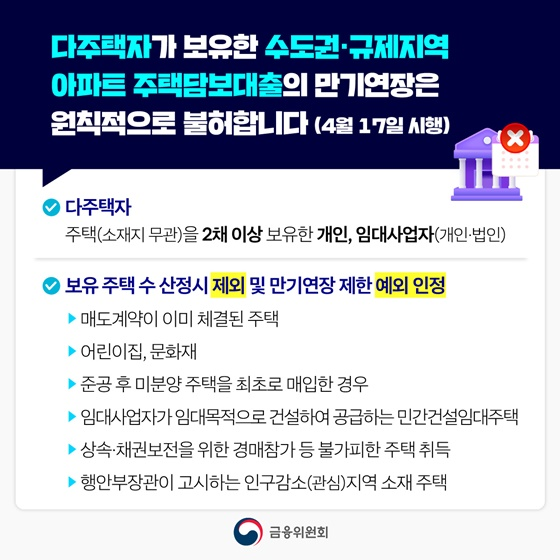
Starting in mid-April, banks are, as a rule, no longer allowed to extend the maturity on mortgages that multi-home owners and rental businesses hold against apartments in the greater Seoul area and other regulated zones. In plain terms: when one of those loans comes due, you're expected to pay it off rather than simply rolling it forward for another term the way borrowers have long taken for granted.
That sounds technical, but the effect is direct. A landlord who was quietly carrying several mortgages, refinancing each one as it matured, now faces a wall instead of a revolving door. The policy is meant to squeeze speculative buying that depends on cheap, endlessly renewed leverage.
The government isn't trying to crash prices. It's trying to make the people stacking multiple homes feel the weight of the debt they're using to do it.
How does this fit the bigger picture?
This isn't a one-off. Through 2025, Korea ran a string of cooling measures — tighter lending in June, a supply push in September, and an expansion of land-transaction permit zones in October. On top of that, the third stage of the stress DSR (a debt-service-ratio test that assumes higher future interest rates when sizing your loan) took hold across the capital region from mid-2025, shrinking how much most buyers can borrow in the first place.
The forecasts for 2026 reflect a market that's been tapped on the brakes. Research institutes expect apartment prices nationwide to rise only modestly — roughly under 1% across the country and around 2% in the capital region — with the pace of any Seoul gains slowing rather than accelerating. Meanwhile some provincial markets, beaten down for years, may finally be edging into recovery.
For an ordinary buyer or renter, the practical signal is this: leverage is getting more expensive and less flexible, especially if you're not a first-and-only-home buyer. Whatever you're planning, build the math around a world where loans don't automatically renew, and where the bank assumes rates could climb. It's a colder, more disciplined market than the one many people got used to.
This article is for informational purposes only and is not investment advice.