600M KRW Mortgage Cap: In 2026, Real Estate Comes Down to Loans
The Korean real estate market in 2026 can be summarized in one sentence as follows. "It has become difficult to borrow money, so the market is splitting."
The two axes that move the market this year are regulation and supply constraints. Among them, the change that actual consumers feel the most is the loan regulation.
The main loan limit is KRW 600 million, and 'moving in within 6 months'
Let's start with the core regulations. The maximum limit for a home mortgage loan to purchase a house in the metropolitan area and regulated areas has been set at 600 million won. No matter how high the house price is, there is a ceiling to the amount of money that can be raised through a loan.
There is one more condition attached to this. If you buy a house with a loan, you have to move in and live there within 6 months. It is a device aimed at so-called 'gap investment', which involves purchasing money through jeonse, but in fact, purchases for investment purposes have decreased noticeably.
As a result, the market is now being reorganized to focus on those who have sufficient cash or will actually reside there. The trend of seeking market profits by raising large amounts of debt has clearly lost steam.
But house prices are rising? Divided market
Even though regulations are so strong, the price outlook is not in one direction. The Korea Housing Industry Research Institute predicts that Seoul house prices in 2026 will rise by about 4.2% compared to the end of the previous year. The analysis is that while popular areas in the metropolitan area are showing an upward trend due to a lack of supply, some recovery is expected as transactions in regions, which had been stagnant, are reviving.
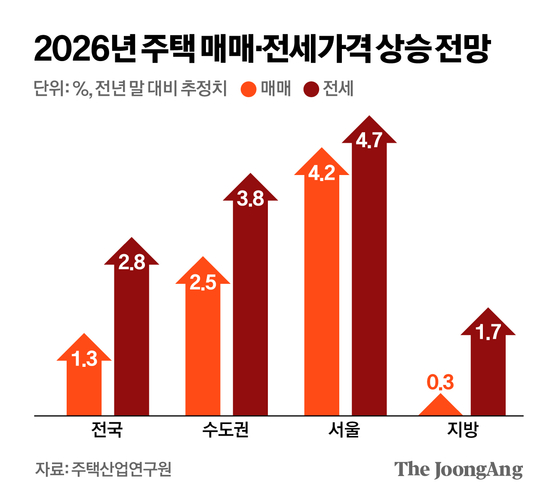
In other words, it is not a market that rises or falls across the country, but a 'split market' with different directions depending on the region and complex.
If lending is blocked, the market will likely cool down, but in places where there is a shortage of supply, prices are holding up. 2026 is the year when those two forces collide.
What real consumers should pay more attention to, jeonse
Unexpectedly, the risk that is quietly growing this year is jeonse. As the number of leased properties on the market decreases due to the influence of various policies, it is said that leased properties are becoming scarce at real estate agents. Jeonse crisis If concerns become a reality, the burden may also shift to end-users who are trying to hold on without buying a house.
In summary, 2026 is a year when real estate should first consider 'how much I can do with my money' rather than 'how much it will rise'. It has become more important than ever to look at loan limits, occupancy obligations, regional temperature differences, and even trends in the rental market.